Friday, July 6, 2012

Put down the duckie!


Oh yes! Another one of those Sesame Street classics. " You got to put down the 'duckie' if you want to play the saxophone!"

The lyrics and melody are as fresh today as they were when I first heard this one back in the 80s. This song was a definite influence in encouraging me to take up the saxophone myself. But like so much of the old Sesame Street, I look back at it today and see meaning on a whole different level. I had a similar feeling when I wrote about how I rediscovered 'Ernie and the Invisible Ice Cream' a couple of years ago. Now Ernie is at the centre of attention again, as Hoots supported by a  myriad of celebrities, explains to him that he can't play the sax if he insists on keeping his favourite toy in his hand. It's a lesson that Ernie takes a while to get, even as Hoots tells him,


 "Don't be a stubborn Cluck!"

I died  laughing when I heard this line today. Sesame Street keeping it 'G' rated, even if just barely.

Anyway, once Ernie realises the wisdom of the advice he tosses the 'duck' away in liberation and goes on to break away into some attractive improvisations. Whether you are a jazz lover or not and even if you've never picked up a wind instrument in your life, you've just got to love it.

The only sad thing is that of course as simple as the lesson is here, millions of people of faith in the world have failed to embrace it. We've begged, pleaded and cajoled just like the artistes in this video, from every corner of the world. But no, believers still haven't got this one into their heads. For reasons which are baffling to us on the atheist side, they simply refuse to put their 'duckies' down.

For years they have been telling us that faith and reason can live together in perfect harmony. That there is no reason to believe that embracing scientific method, logic and critical thinking means we have to toss aside faith. In fact more than telling us that faith and reason can go together, they claim that we actually need to have both in order to have a balanced life. Truth is, that trying to put reason and faith together is just the same as attempting what Ernie is trying to do here. Sax in one hand, 'duckie' in the other and hoping the music will come out just right. Nine times out of ten, it won't. Stories of six day creations, global floods, ladders to heaven, talking snakes, virgin births, resurrections and the like just don't stand to reason. If you include these in any manuscript of science you will have problems.

Putting faith and reason on the same level is like trying to compare the skill needed to squeeze a bathtub toy with that needed to master fingering, breathing, reed control that comes with learning to play a wood wind instrument. It is not discrimination to say that the 'duckie' can't be a part of any self respecting band. 'Duckie' at playtime in the nursery and in the bathtub can be fun, and the squeaks it emits can make you laugh and giggle in delight. But there is no room for this if you are talking about playing serious music.

I suppose some Christians would say that strictly speaking Hoots is not correct. It's not impossible to play the sax while holding a 'duck'.Obviously it can be done, and the music might sound alright some of the time. In this video, the music Ernie plays with 'duckie' in hand is not terrible, some of it is actually quite nice. Especially when he is just holding the duck without squeezing it. But once he tries to interject the duck sound into the music, that's when you get the dissonance. This happens with many  liberal Christians. They keep the 'duckie' in their hand because they feel it is necessary that people see them with it. It's basically aesthetics, to show that they still have a connection to that special gift they were given in their childhood. They want it to be known that they haven't forgotten where they came from. Indeed, they don't really intend to squeeze the 'duckie' while they are playing, and with practice they come quite adept at keeping the 'duck' silent during the music or at least from interrupting the flow of the piece.

But even as they show off their skills you can see they have to try twice as hard to keep the 'duckie' out of the way while they play. Even as you stand to applaud them, you still have to wonder why they don't make life easier for themselves and everybody else and just leave the 'duck' alone. What is the most awe dropping thing is what happens after the music ends, when they declare that there is no way they could even play a single note without their duckie.  All the duckless people like me can say to that is, "What? The duck?"


It's not only the duckless that are a bit mystified though. Even as the 'duck and sax' people accept their praise they upset the true 'duckie' aficionados, those that believe in the true beauty of pure 'duck' music. How can he say he needs his 'duckie' when he never even uses it? They will say. Oh, how I wish these 'duck and sax' players would answer that 'ducking' question.

However, in reality very few 'duck and sax' players are actually skilled enough to always avoid their fingers slipping on to the 'duckie' during performance. When that happens, you hear that 'silly squeak' that Ernie talks about. This  'duckie' sound may be unintentional, but it doesn't matter. It still plays havoc with the music and usually you get a massive discord. It's embarrassing when this happens because the player then has to pretend that the 'duck' squeak is not a mistake but a vital part of the composition. He will say that if anything sounded off in the music, it was in fact the sax that was the problem, because it gives trouble sometimes. In contrast, the squeaky 'duck' always come in at the right time and in the right key.

Of course what happens every now and again is that the 'duckie' squeaks by chance and it actually sounds good. It fits the music perfectly, resulting in an enticing chord or exciting syncopation. Here is when the 'duck and sax' players do their most talking. They will make sure to show the video of that performance over and over again to prove that the 'duckie' makes the music better. If we tell them that it was just a fluke note, they will laugh at us and try to ignore us when we list the millions of times the 'duckie' has ruined performances. They will say we are taking those performances out of context and deliberately choosing only bad examples to make our case. They will add that in any case, we are not skilled enough to understand what is good 'duck and sax' music because we can't play it. We can't judge what we don't understand.

Unsinkable Rubber Ducks

James Randi- Speaks of Unsinkable Rubber Ducks
Yes, if only it was as easy as in this video to convince the Christians and other religious people to put down their 'duckies.' In fact 'rubber duckies' are so much tied to religious thinking that the faithful themselves are  often indistinguishable from the artifacts of make belief  they carry around in their hands. James Randi the famous skeptic and debunker of supernatural claims has often noted this in his talks. He refers to many of the frauds and scammers especially in the evangelical churches as 'unsinkable rubber ducks.'

He explains that these guys are able to float back up to the surface no matter how much force you use to push them down. You can have evidence to catch them red handed in some act, they always find a way to come back. Most notable among these 'ducks' is Peter Popov who Randi showed was using an earpiece that picked up his wife's voice reading out the names of the people he was 'healing' during services. Popov was clearly pretending that some divine voice was revealing names and addresses to people in his audience. It is hard to imagine how a person could be more 'caught in the act.' However, it was only a blip for Popov, he was soon back on the air and continues to this day raking in even more millions than he was at the time he was exposed. Yes, you just can't keep these guys down.

Ducking experts

The phenomenon doesn't end with people like Popov either. I know many Christians personally and online who are true duck experts. Yes, no one can duck the difficult questions like these believers. Here are some examples of questions I haven't got a straight answer to yet.
  • Does everything happen according to God's will
  • If God told you to murder your daughter would you do it?
  • Why has God not exterminated the devil yet?
  • Why does God need to have a blood sacrifice in order to forgive us? 
  • Do you consider it moral for a God to send someone to hell just for not believing
You won't believe the amount of ducks I have heard in response to questions like these. When they can, Christians make use of their elasticity too. In their world, whatever the brain can conceive, faith can achieve. You have to try to catch them out with logical contradictions. But even that can't keep them down, because they will argue that God himself can transcend logic. It takes ages to try to convince them that if God and us operate by different rules of logic, we can't communicate with him or begin to understand anything about him. By the time you do that, you are sure to have forgotten what the logical contradiction you were trying to call them out on was in the first place.

In the cases where both their ducking and elasticity fails them and they end up in hot water, they will fish desperately for a response and eventually distract us by throwing out a red herring. Those Christian rubber ducks, you just can't ever win.

How can we overcome the ducks?   

Well, at least so it seems. We have to take heart from this video. We have to take this Sesame Street lesson. The first thing is repetition. We have to keep telling them to 'put down the duckie' even when it seems the message isn't getting through. We also need  a variety of people bringing the message. People of different ages, genders, races, cultural and ethnic backgrounds,  just like the celebrities in this video. We even need different languages, as Celia Cruz says " Suelta el Patito."

One person, however persuasive they may be, is seldom enough to turn the tide. We also need different ways of packaging the message, just like the different styles and genres of music we see in the video.It doesn't always have to be loud and strident. Sometimes soft dulcet tones whispered in a friendly way can be just as effective. We see that here. Arguably the best part of this video is 'Put Down the Duckie' rendered softly by the group 'Ladysmith Black Mambazo

The other key to learn from here is that as strongly as we bring our message, we must never coerce. We have to understand when they tell us like Ernie, that they can't bear to be parted from their 'duckie'. It is important to note that Hoots never tried to yank the 'rubber duckie' out of Ernie's hands. Ernie tossed the thing away himself in his own time, when he reached the point that HE was convinced. The only thing we have to remind people like Ernie is that it's OK to take the duck up after sax but only if its for playing PRETEND.Yes, we must not be afraid to tell people that their 'duckie' is an imaginary friend. Sure they can talk to him but they are not going to get an answer back. As tempted as they may be, they must  never take out their 'duckie' at school during classes especially if its a science subject like Biology, unless  they want to become  'quacks' when they grow up.

All jokes aside though, the last thing we can do to help our cause, is to take things beyond this Sesame Street clip. We have to let believers know that when we implore them to put down the 'duckie' we are not putting THEM down. We have to hold up high others among us who have successfully, 'put down the duckie' and produced great music.

Andre Woodvine- Barbadian jazz saxophonist.
Put down the 'duckie' and is one of the Caribbean's finest

One such person in Barbados is leading jazz saxophonist and composer Andre Woodvine, who has made a name for himself throughout the region. You can find out more about him and his music here. He my friends, has emphatically put down the 'duckie'!

Andre contacted me through this blog last year as he was becoming public about his atheism. I was touched by the positive things he said about my writings. I was extremely excited to make the link with him and we have interacted quite a bit since then. I have always admired Andre as both sax player and composer. I will never forget his composition 'Hold You in a Song' performed by John King and Alison Hinds, that went on to win the Caribbean Song Contest back in 1992. It  remains a favourite of mine to this day. Andre  himself  had a memorable sax solo in that one, you can listen to the entire performance below. It was great to find that music and saxophone playing was not all we had in common. Andre is now open about being an atheist, as he continues to fly the national flag high, representing Barbados as a jazz musician all over the world.

Thank you Andre, for giving the message so loud and clear to the rest of us.


"You've got to put down that 'duckie' if you want to play the saxophone."


Saturday, June 16, 2012

The one behind the wheel is all that matters: Why the moral argument for God drives me crazy

It comes with the territory. Once you become an atheist, you have to be prepared to get the arguments for why there is a God from left and right, almost on a daily basis. The theist doesn't have to use an indicator, we know the arguments that are coming just around the corner. First cause, complexity, meaning of life, Pascal's Wager along with a string of anecdotal testimonies and near death experiences in tow. Their discussions always take you down the same road. The potholes of fallacies don't matter, they just hope that one day one argument, any argument will bring you back on the highway to Christ. By and large such arguments don't bother me, I shrug my shoulders, sigh and give the defence of my position if I have the inclination, knowing that if the discussion continues there will be more roundabouts ahead than there are on the ABC Highway in Barbados. However, there is one argument that really does drive me crazy .I am sure for many atheists it is the same. It is the moral argument for God.

Here is how it goes. The theist will say that the fact that we can all recognise 'good' from 'evil'  in the world suggest that 'good' and 'evil' can be defined objectively. There are concepts that are not simply matters of taste or culture. The fact that they are not dependent on an individual human, means they must be dependent on an an individual non human. Therefore God. That's it! QED!

This argument is an extension of the Cosmological argument or the argument from origins. What it comes down to is this. We have a 'something' in the universe. That 'something' needed to be created. Therefore God created the 'something.' That 'something' can range from physical things such as universes, trees, planets, puppies, sunsets, babies and chimpanzees to abstract things like logic, love, consciousness, intelligence and yes, morality. So from an intellectual perspective the moral argument should be able to be dismissed just like any of the other , 'Who created X?' arguments. But no, this one goes much deeper than that. It hits me harder becomes implied in it, is the notion that the morality of people who don't believe in God or some supernatural agent are morally compromised in some way. That is the part that offends me.

Throughout my life, if there is one thing that I have always tried to do, it is to live to the highest moral standard possible. Back from when I was a Christian growing up in Barbados, up until today, living in Canada  where I solidly identify as an atheist. When it comes to the desire to 'do the right thing' my religion or lack thereof  plays no part now and it didn't play a role before either. I always saw my faith as incidental to my sense of morality. Christians will say it's God, atheists will say its a consequence of my evolutionary history, but whatever the reason I have always felt torn up inside when I have recognised that I have done something that has hurt another individual. I have always told people that I don't mind being called stupid even as I try to make good decisions. But being labelled as evil or unethical is something that hurts to the core.

I can hear all my Christian friends saying in chorus," No, no, you have it all wrong ! We know you are a moral person, we know you are good.What we are saying is that you don't have a basis for determining your morality!"

Borrowing morality form them

This is the point when I feel like tearing my hair out. It irks me more because when Christians say this, they say it with a tone that suggests they are being magnanimous. That we should be praising them for being so compromising, for telling us that we CAN be moral. They seem genuinely surprised when we are  unimpressed by what they perceive is a fantastic compliment.

Why are we unmoved? Let's explore this statement a bit more. ' We can be moral, but we have no basis for morality.' The implication is that they are the ones with the basis. Some say that we atheists are simply borrowing their morality from them. Suppose a white person came up to me and let me know that he has a lot of black friends and from those interactions he knows that black people can be good people, even though many of his white friends argue otherwise. What if he went on to explain that his view was that although most blacks were moral they had no basis for determining what was moral? Suppose he added that what we good black people are doing is behaving 'white like', copying the moral code of HIS people, even though most of us don't realise it. What if he continued by saying that white people that are evil are either not true white people or white people who through a conscious rejection of their race based moral code have lost their way? Should I  look at a person who suggests something as ludicrous as this as anything but a flat out racist?

I know it will be said that race and religion are too totally different things and the analogy doesn't hold. I disagree. I fail to see how a difference in opinion about what is the essence of nature has any more to do with how good a person you are, than the melanin content in your skin.

There is something even more curious about this morality argument that I am not sure even all atheists realise.  Their argument for an objective morality is based on the universal interpretation by  human beings of concepts such as 'good' and 'evil.'  In 'universal', they are including atheists, agnostics, spiritualists, Hindus, Muslims, Jews, every conceivable religious and non religious group. All these people's perceptions on 'good' and 'evil' are used to support their view that an objective morality exists.

Then comes the big sleight of hand in their argument. The God that is responsible for this objective morality that everybody recognises, is their God that only followers of their God recognise. It's a strange notion. It's not like the old days when a God just concentrated of taking care of his people. Their God takes it upon himself to step into everybody's territory. Their tribal God is responsible for the universal experience.  But this tribal God is not just any God. This tribal God is one who has advocated every atrocity in the book at some time or another. Genocide, infanticide and  much much more. Yes, there are many  'cides'  to God. In fact the only 'cide' that God seems to have evaded so far is 'suicide', well unless you want to count that 'hanging on the cross' weekend a couple of millennia ago.

So, naturally confused atheists ask Christians how can they claim that their God is the establisher of objective moral good, when so many of  his actions are in direct opposition to the objective morality that we humans universally recognise? The answer we get then is the real 'slap in the face.'

"You can't judge any actions of our God because you have no basis for morality! You have no licence to criticize! How can you say that even killing babies is evil?"

Apart from the obvious ad-hominem in this response, there is a bigger problem. In determining the existence of universal, objective morality they took into consideration the views of ALL humanity. The fact that OUR atheist view of morality is similar to theirs was seen as evidence in favour of 'objective morality', which was a crucial part of their argument for the existence of THEIR God. Now that they have used our moral perspective to help 'establish' their God's existence,  they want to dismiss that same moral perspective when we use it to challenge their God's morality. Effectively what they are telling us is that we can vote their God in but we can't vote him out. It's a one way democracy.We need to call them out on this inconsistency.

Debating Mistake?

In the last post I made on Imagine No Religion 2, Matt Dillahunty took me up on a comment I made where I said that even if he made a mistake in a debate he had enough consistency in how he structured his argument to not falter or get tied up. He asked me in the comments thread of that post  to point out to him if he made any mistakes during the debate in Kamloops. He playfully added that he didn't consider that consistency in making mistakes is a good thing. I smiled at this, because the comment about him making mistakes was a passing statement within a paragraph that was very complimentary of him and the work he does. Still, I suppose it is human nature to pick out any note of criticism, I am sure I would do the same. It's great however to see someone of his stature in the movement seeking constructive criticism. That is the true strength of the atheist community. In that thread I outlined one area in which we had a difference of opinion and I won't go into that here, you can look back at the comments in that thread if you wish.

However, Matt's comment did make me reflect on 'mistakes' of atheists a bit more. Not just his, but those of all of us. That's what I am getting to here. When theists tell us we can only get an understanding of morality from God, we challenge them on it and try to show them how patently false it is. In so doing  we take ourselves further and further from the person that they see as the law giver and this opens up the chance for them to claim we have no grounds to criticize them since we have gotten away from the one who makes right right. Perhaps what we need to do is just leave them with their assumption and say that we don't know where our moral instincts come from, and yes maybe their God did give us them. The point is that it doesn't matter, we have moral instincts which clearly work well enough for the majority of us not to be  mass murderers. As such, we have all rights to challenge the morality of the God that they claim set the rules.

Even if our basis for morality is borrowed, it is still every bit as valid and we have every right to use it and have confidence in it. If I am driving a car on the highway, I may claim the car is mine, someone else may claim it isn't. They may claim I borrowed it, rented it, even stole it. My parents may have handed it to me or I might have won it in a raffle.The fact is that none of that matters once I am driving it. I have the same rights and responsibilities as every other road user. You are obliged to give way to me if I have the right away,  you can't expect to run a red light to overtake me. It doesn't matter who owns the vehicle, who made it or how it got to me, it matters only who's behind the wheel. Once I have successfully passed my driver's test and have fulfilled all the legal obligations of the jurisdiction I am in, I have license.

August Berkshire- 'Does God put the moral instinct into our brain? If so, do his fingers slip during the rewiring?'


Speaking of morality and license. I have to mention August Berkshire here. He gave a memorable presentation at Imagine No Religion 2 on the topic of morality in the bible. It was one of those presentations that had the impact of making me gasp time after time. It was basically God and his criminal record  put together in Power Point. Forty two she bears led us off on what would inevitably become a very bloody parade. I don't know what it is, but there is something about seeing God's old testament tyranny on the big screen that makes it seem one thousand times worse than reading it on a lap top. After his presentation, you could be left with no other conclusion than that God is a monster. It was  the one presentation that weekend that I genuinely wished my Christian friends were there to see. For in spite of the horror presented, their was no twisting of the context of the stories to suit an agenda. It was just a retelling of what was right there in the book. It would be hard to know what they would have said in defence. He scoffed at the idea that God could be the one putting the morals in our brain. "Maybe his fingers slipped during the rewiring!" he quipped.  He ended by saying that if God existed and had the record that we read about in the bible, he should be the one praying to us for moral guidance. It was hard to disagree.

One other focus in August's presentation was the image of the photo above. The car he drives in his hometown in Minnesota proudly displaying "ATHEIST" on his license plate. He spoke of a few awkward discussions and hostile reactions at gas stations but he also spoke of the smiles and 'thumbs up' he got from many people, especially young people. It is heart warming to recognise that those of the future realise that the atheist label is one that we can display without fear wherever our travels may take us.

It is worth remembering that whatever its origin, whatever the car maker's name is, whoever is the mechanic, morality becomes our vehicle once we buy into it. We are also free to customise our plates to suit us. Once we are not breaking state laws, we have right of way. We are the one's in the driver's seat and unless you have evidence that we are not in control of our mental faculties, we have every right to be on the road and call you 'idiot' if you do foolishness and endanger others' lives. With all due respect, you are the ones that are driving under influence. You need to look at yourself in the mirror.You can't dismiss our rare view because your rear view says that our rare view can't tell you that you're wrong.

Given all that many of you believers think about us, it is a miracle that we actually still have models of morality that are allowed on the road. Especially given the fact that we, unlike you, are not eligible for 'Accident Forgiveness Insurance.'

Thursday, May 31, 2012

Meeting Matt and Seth and more: Reflections of an exciting Imagine No Religion 2

It happens over and over and over again. Each time I think that I have reached that one moment that defines my atheist journey, something comes along that blows that previous landmark straight out of the water.

The weekend before last in Kamloops was another one of those 'moments' that had that toppling effect. As I got ready to leave from Calgary there was a definite feeling of excitement. So much of my atheist life is typing away at a keyboard, communicating with anonymous souls at various corners of the globe. I have been to many meet-ups now, had my share of one to one interactions, but this was my first atheist 'mass' event and I figured it was not going to be like the old time Sunday morning ones. For some reason I felt a bit of apprehension. I was not quite sure why. I was just going to observe. I was not a speaker or presenter. No need to worry about things like computer compatibility with equipment, flash drive failures or mixed fonts on power point slides.

Still, it felt strange, like if I was  going on some type of pilgrimage into the unknown. I think it is because in many ways this was my first real 'journey' into atheism. Yes, I have gone out of my way to meet with atheists before, as I did last year in the Caribbean and New York. But those were different, I happened to be in those places for other reasons and I took the opportunity to make allies, connections and friendships. Now, it was me venturing out somewhere and atheism was the only reason. This was no little sojourn either, this was an eight hour road trip. Something completely outside the experience of a little island boy growing up in tiny Barbados where a 45 minute drive is considered an excursion.

Well, how did it go? Firstly, please don't ask me anything about Kamloops. I have no  idea what it looks like, although I can tell you the views of the mountains on the way there were amazing. The weekend was spent totally on the hotel premises. Hotel room, convention centre, bar that was the program. Three in one and one in three, that was the simple trinity.

Atheist and Proud

It didn't take me long to realise that this was a bit different from your average atheist meet-up. Of course nowadays there is nothing particularly strange about me being around people that are deity free, but what I realised was unusual was the way that the people I met felt about their non belief. It was something they wore proudly and were excited to talk about. There was none of that energy zapping apathy that I have experienced from time to time in other places. Those people that tell you they don't believe in God just like they don't believe in unicorns. The ones that say that it makes as much sense spending time talking about one category of mythical being as it does another. No, I didn't meet a single example of that type of non-believer. I met 'out and out' atheists and some people who identified primarily as humanists or skeptics, but nobody who said that they felt that calling ourselves atheists was something we should go out of our way to avoid.

What I saw on show in Kamloops was atheist pride and it was heart warming. I can't count the number of times I told my 'coming out' story and I remember even while I was talking being able to hear four or five simultaneous discussions around me where others were doing the same. I now understand why so many atheists get energized by these type of gatherings. These events often require a bit of travel to get to them and like any other conference, are not exactly cheap. It stands to reason, that those that make the effort to be there have a passion. That combined energy is something amazing to feed off of. It's something that I hope every atheist I know gets to feel one day.

Still have to work on diversity

Another thing that stood out about the audience was the racial mix, or should I say lack of it. To put it diplomatically there was a pronounced melanin deficiency. Indeed up to about two minutes before the start of the event I had spotted not a single other black person, in spite of the fact that the room was filling up and had to be close to 300. Eventually two others were spotted and we had a great time laughing and joking later in the evening about the rarity of our species in this particular gathering. It was funny that the three of us were thinking the same thing at the same time as we entered the auditorium.


Crommunist - ' I  just care too much, I have to, have to, have to write.'

 Me with  'Crommunist ' 
Both of these gentlemen of colour had interesting stories to tell  that were inspiring in their own ways. There was Ian Cromwell aka  "Crommunist" a blogger from Vancouver, who blogs on the popular Freethought Blog. It was great to have an extended conversation with a fellow blogger. Speaking of the challenges of writing when you don't know who's listening out there. Crommunist blogs everyday! That is something  that still amazes me. I loved his passion for writing and he certainly gave me great encouragement to keep on keeping on.

 Matt who had come up from Las Vegas, recently identifying as an atheist and  was making the trip to find a new community. It was great to meet them both. Sometimes I feel a bit guilty about concerning myself with the ' find the other black people' game when there are so many other things to be thinking about, but it is natural. Of course this lack of black is something that has been mentioned in the atheist movement quite a bit and obviously work still needs to be done, but that is a subject for another day.

As it turned out, there were a lot of the Calgary skeptic community that made the trek up, so in a way it was a bit of a home away from home. I began to realise how fortunate I was as an atheist, to live in a city like Calgary. I think we were the city with the most representatives. We got quite a few comments from others about how tight we all seemed to be. It is true, there is quite a bond between members of the Calagary CFI crew, even though we badly missed having our president Nate Phelps around. A person whose inspirational story speaks to many in Canada, USA and thousands across the world.

The weekend certainly had its moments of humour. It made me laugh to see members of the skeptic community try to maintain that cool rational exterior while you know that inside there was a teenage rock star groupie within them when they saw Matt Dillahunty walking through the restaurant or PZ Myers hanging around the lobby. There was a memorable moment when a youngster out of breath  ran up to me and said

" I just met Lawrence Krauss in the elevator and I wanted to say something really profound to him, but all I could end up telling him was that he was much shorter than I imagined, I feel like such an idiot!"

This was typical of the sort of thing I heard right through the conference. I even heard talk going around that  the well known youtube atheist 'Thunderfoot' was in the house. That one turned out to be just a rumour, proving that atheists are by no means immune to believing unsubstantiated claims.

Changing attitude

By the end of the first evening , I could already  feel a change in myself. Before that  night in British Columbia, whenever I told someone that I was an atheist, it was a statement I made cloaked in a thick veil of  'I am sorry.' The idea I would portray was that I wished I could say I believed in their God, but I just couldn't. Here, it was hitting home to me in a big way, that we have absolutely nothing to be ashamed of or to apologise about. We are honestly making a judgement based on what we see in reality and there is no way that that should be seen as something with a shred of negativity surrounding it. I vowed even as I was there, that I will never be apologetic about saying I was an atheist again. If that is one thing that I can stick to as a result of Imagine No Religion 2, that on its own would make the entire experience worth it.

I kept remembering as I spoke with these people that my dictionary told me that atheism is simply a 'lack of belief.' That seemed so incongruous with what I was seeing here. 'Lack' was just not a word that fit anyone I met. This was a group overflowing as much in spirit as they were in spirits. There were many differences expressed on topics relating to things like gender, diversity and vegetarianism in informal discussions. It did get rather heated at many tables in the bar. But, there was no doubt in my mind that this was a family, and in spite of how recently I had come acquainted with this movement, this was my family.

There is so much that could be written on the weekend, and I took copious notes while I was there. I have about a page or two on every speaker. Each of them brought something unique to the table and it is an almost impossible task to single people out, to say nothing of all the informal discussions I had along the way and our Sunday 'Revival Service.' What I will do is to file all of these writings away and  bring them out over the next few weeks and months. Some things just need the appropriate paragraph space to give them their due and I don't want to be giving anyone an overdose of writing today. After all, it's not as if this is blog about homeopathy.

Matt Dillahunty- ' God should be found not guilty of the crime of existing'

 with Matt Dillahunty ' The Atheist Experience'
I'll focus for the time being on two podcast  personalities  that I was anxious to  meet on this trip as well as the speaker that I think ultimately made the biggest impact . The first podcast personality is Matt Dillahunty from 'The Atheist Experience.' Matt has no books penned, no tenure at a prestigious university, but there is no doubt that Dillahunty is a star in the movement.  Say what you want, but when it comes to talking, few people can touch the 'kick ass' host from Atheist Experience. In my travels talking to atheists from the Caribbean to Calgary to Kamloops, everybody loves Matt.

I discovered "The Atheist Experience" in 2008 when I was still identifying as a Christian. I was impressed by how the show broke down the arguments for God so clearly and logically. Matt was particularly skilled in this regard.That show for about one year and a half was my only link to atheist conversation. The only place I heard such arguments addressed. It eventually helped to dragged me from a weak form of agnosticism to firm non belief. I know that show has played a similarly significant role for countless more.

The great success of the show has of course thrust Matt straight into the limelight which he recognises and  seems at ease with . From the time he walked into the hall for the Friday night debate, hands were reaching out from the aisles to him. His nonchalant reply was ," It's Ok I am  going to be here all weekend."

Matt distinguished himself in the debate, although I thought Chris di Carlo our other representative was also very effective. What impressed me about Matt in the debate was the quick and confident way he would respond to the theist questions put to him. This I think is the great advantage about being on a show like 'The Atheist Experience' for so many years. Practice really does make perfect. It's like playing chess, Matt can often see the move that the opposition is lining up for way ahead of time and he can be sure he is not going to find himself in a trap. I have seen other atheists in debates, hem and haw rather more, which is understandable, because often answers to questions are not clear cut and you want to be careful that someone doesn't run with a wrong context. Matt, even if he makes a mistake, has a consistency in the argument that makes him hard to beat. It was a delight to see him in action. I love the way he said that God should be found not guilty of the crime of existing.

It was also great to sit with Matt after and hear him talking.  He is a man always ready to chat with anyone and debate issues rigorously, enjoying having a keen audience of listeners around him. If you think that Matt is sharp and clinical on the show he is even more so over beers. I think it is his straightforwardness and honesty that people like even when he's in a hostile mood. Atheist Experience fans all know that no one can say "You're done!" quite like Matt.

One thing Matt said that I will remember was an answer to a question from a fan about why he does the show. What motivates him? His answer was simple. " I do it because I give a shit!" I don't think there is any better way you can put that. It was a good motif for the weekend.

The Thinking Atheist- Showed  us the 'theist songs' with lyrics that never change.
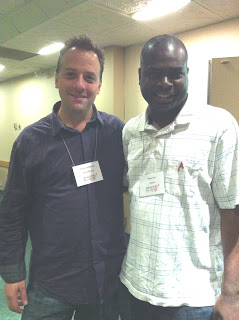
 with Seth Andrews ' TheThinking Atheist" 
The second of the podcast protagonists I wanted to see at the conference was Seth Andrews , 'The Thinking Atheist." Perhaps my moment of the weekend came through the way  I met him. I was sitting listening to PZ Myers' talk at the back of the auditorium. I heard this person whispering asking me if the unoccupied chair next to me was taken. I looked up to realise it was none other than Seth himself, the host of the popular podcast and several great youtube videos.  I invited him to sit down and he greeted me with a simple " Hi, I'm Seth" and then introduced his spouse Natalie. I introduced myself and told him how I was pleased to meet him. Then we just simply settled back down and continued watching the proceedings.

This was a bit of an unreal moment. I don't think Seth knew whether I even knew who he was. In off stage personalities, Matt and  Seth could not be more different. Seth seemed  so different to the vibrant personality on the airwaves. Here he was quiet and unassuming even maybe a little nervous.  It occurred to me at that moment, that Seth's frequent discussions on his program about the overwhelming challenge of being a speaker at this conference among the PhDs and other lettered speakers was by no means false modesty. In a sense, I could understand where he was coming from. This was not one of those conferences of, 'I used to be a Christian and now praise the Lord I found reason.' This was much more along the lines of a university lecture series, dealing with issues of social psychology, gender discrimination, theoretical physics and the like. Seth was obviously coming from a vastly different kind of angle.

What Seth didn't know as he sat there, was that beside him was someone on  whom he had a profound influence. Seth  is fast becoming one of my favourite people in the movement and this weekend in my eyes only enhanced his reputation. A down to earth guy if there ever was one. His voice is far more famous than his face and  for that reason I think many people passed him by in the conference without too much fuss. But for me he is one who always resonates. I think it is partly because he, like me, let go of the faith approaching the age of 40. Like me, he was a little bit late arriving at the atheist party, but I think he has a quality  that sets him apart from many other atheists out there.

Everybody says, it's the voice. Yes, that's undoubtedly part of it, but not the whole story. It's the way in which he can change your emotion on a hairpin. In a single show he can make you laugh hysterically, feel motivated and empowered, get pissed off and sit in silence on the brink of tears. All this through the inflexion of the voice, the pause for effect, variations in volume and speed of delivery. It is a talent that few have and even fewer within the skeptic community. Others tend to have a personality which swings markedly either towards confrontation or compassion. Seth has managed to get that 'good cop, bad cop'  balance almost right. I know Seth feels that we give him far more credit than he deserves but I think he is just too much involved on the inside to see the full extent of the impact he makes on those of us out here.

One thing he said that I took to heart on one of the first of the programs I listened to with him, was his advice to know your strength, concentrate on that and try to excel in it for the benefit of the freethought community. For him, his talents are radio and video production and he has given that in huge proportions to the atheist community. He made me think about what I could bring to the table that could make a difference out there. Where was my strength? For me it is writing, at least that's what other people tell me, so I have just concentrated on the blog, writing on atheism and faith and capitalising on the talent as much as I can. People have asked at times why I don't do different things. Diversify a bit, maybe do videos, write on other topics. Perhaps get into talking on wider skepticism, psychics, alternative medicine, racism, gender, sexuality, there are so many other things out there that need to be addressed. Maybe, one day I will do those things, but I am concentrating on where my strength is, where I believe I can really make a difference. Expounding on issues relating to atheism and trying to emphasise the logical frailties of the theistic position, using metaphors and examples that will make the point without provoking anger. It's the type of writing I think I do best and I have stuck with it, hopefully improving as I go along. I leave people with expertise in other areas of the movement to take other approaches. I have to thank Seth in part for giving me that little piece of advice.

Seth asked me how long it took to get to Kamloops from where I lived. I told him the drive was eight hours. He seemed to find it incredulous that I would travel such distances to hear these talks, I am sure he would have fallen out of that chair I said he could sit in, if he had found out that the fact that he was in the lineup was a large part of the reason that I made the effort. It seemed it was worth it for Seth to sit next to me too. He was rather taken by my computer that I had with me to take notes. It was my all in one ipad case/stand  and bluetooth keyboard. I had no idea that he was watching my machine the whole time. I wondered if he was watching the screen too. If he had, he would have seen me write the words,

"Seth the Thinking Atheist has just come up and sat next to me as I listen to PZ Myers. This is just unreal"

 Boy would it be funny if he read that. Thankfully, I don't think the font was big enough.

Seth's presentation itself did not disappoint and his visuals were some of the most memorable of the weekend. He just transformed when he went onstage and became "The Thinking Atheist" we all know and love. Using his DJ experience he spoke of the 'theist songs' we hear over and over again.  There was also the tribute to Carl Saigan video that again made it hard to keep back the tears. He seemed himself overcome when he admitted to the audience that he was 38 years old before he discovered Saigan. I felt like putting up my hand as well to say I was in my 30s too when I first came across his work.

Maryam Namazie-  Threw out a Challenge to Secularists

My eyes  remained moist for the next presentation. Maryam Namazie an activist from Britain and strong spokesperson against islam extremists was next up and  she seemed to have drawn a difficult position after Seth and before the keynote world class phycisist Lawrence Krauss. She started in a rather subdued manner.  She spoke about how this was only the second time she was using power point and apologised in advance for the quality of the slides. She quickly got into stride however and shook up the audience, proceeding to give a presentation that was full of passion. So great was her impact that she earned the only standing ovation of the entire weekend. It struck me from early that her discussions on the absurdity of islam got muted laughter compared to the belly laughs that pokes at Christianity had got over the course of the two days. It is poignant to recognise that even in an atheist conference, there is a little fear we all live with when it comes to making fun of islam and the Koran. In any case, as she went on there became less and less to laugh about as details were given for the science behind determining the correct size and material to use for a stoning  of a woman, to ensure that death does not happen too quickly nor too slowly. Yes, there is actually a 'just right Goldilocks' stone!!!

Maryam appealed to us in the audience to play our part in speaking up against such injustices as members of the secular community. She spoke of people in the middle east facing jail time and death for the crime of blasphemy. The young man in Indonesia who faces death for saying that "God does not exist." on his facebook page and others in trouble for posting ' Jesus and Mo' cartoons. At that moment I remember thinking about how much I had to be thankful knowing that there are many parts of the world where I couldn't write an atheistic paragraph without getting a death sentence.

Trying to find my niche

I  recall also feeling rather small about my part in the freethought movement when I was listening to Maryam. It seemed that writing  light hearted blogposts about God and how we know he 's not here, was rather trivial compared to other work that needed to be done, urgent civil rights issues that had  to be dealt with where religion was the entity wielding the  big stick. Then I remembered what Seth said about concentrating on our strengths. I also remembered that the church used to tell us that we as members were like different parts of the body, all working together to do God's work, none was more important than the other. The atheist community is like that too. We have hands and feet, eyes and ears, lots of mouth, plenty of spine, brains in abundance and as a friend of mine reminded me, some of us are rather skilled at being dicks.

So, I recognised I didn't have to be me at the forefront of every activity. I can give my support, but it is important that I keep my fight on the front where I engage. I remembered how long the journey was to get to Kamloops. The one that began long before 5:00 am on a Friday morning in Calgary. It all started because I was able to look at myself, question my deeply held beliefs and realise that I was part of the problem rather than the solution. From that point I have reached a stage where I can now see what needs to be done, which is at least a start.  There are many ways I can think of helping the cause now, but none of this could have started without a doubt. Without a doubt that told me that what I believed might not be true.

Got to keep knocking 

So, now I need to pass it on, just like the popular church song tells us. In the comedy show we saw on the Saturday night of the conference, there was a routine that imagined what it would be like if atheists used to knock on doors to spread the ' Not so good news.'  It was brilliantly funny but hearing it in conjunction with all the speeches of the weekend made me realise that we in the atheist movement do need to start doing some of this door to door stuff.

For the Christians that keep knocking us we have to give them something back. Yes, we too have to start knocking on doors. Not on the ones that Jehovah's Witnesses and Mormons exercise their knuckles on, but on the ones that are embedded in walls that cordon off the brain. Those that keep minds forever locked off from reality. Those for which it seems faith alone is the key. We may get ignored for a while, people may refuse to take a break from their their busy daily schedules to hear the 'Word' that we bring. They may consider our interruption to their 'thinking as usual'  to be a nuisance and warn us to get off their property. But if we can go through the neighbourhoods with the type of people I met in Kamloops, the persistent pounding will one day become impossible to ignore.  Those sitting comfortably in their houses of faith, will then  feel obliged  to peep through that small crack in their curtain and will realise to their surprise that there is indeed light on the outside.

Monday, May 14, 2012

The rules that rule the ruler: The bigger the Bible the smaller the god

It's all about the tough calls. This photo on the left always gives me chills. We see Obama, Biden, Clinton and the rest of the White House staff watching anxiously to see whether the raid to get Osama Bin Laden was successful. The anniversary of this event was two weeks ago and of course it was played out in the media, with Democrats making political capital by reminding the public of this more meaningful 'mission accomplished' moment and the Republicans playing their own politics by claiming that the Democrats should not be political.

Whatever your  political leaning, you have to admit that this was a true leadership moment for Barack Obama. This is why countries have presidents, prime ministers or chancellors. It's to make difficult decisions like these. In the midst of uncertainty and ambiguity, you have to weigh up the options and make the call realising you have to live with whatever the outcome is. The advice may come to you from all directions conflicting and contradictory. History and precedent may be there as a guide, but at the end of it all the buck stops at you. Maybe due to shrewd judgement, maybe through some luck or perhaps a bit of both, Obama came out smiling at the end. You have to take risks sometimes as a leader and you deserve the accolades when it works as much as the brickbats when it goes wrong. To make the decisions when there is no clear answer. That is what a ruler does.


Fast forward to last week and the US president was back in the news again. This time the call he made was also impactful, but in an entirely different way. The president referred to his 'evolving' opinion that now is in favour of same sex marriage. This was indeed  a significant departure from the form of his previously held transitional belief. I hope creationists will now recognise that macro evolution can occur given enough time and the right political environment. To me it was a welcome evolution, but others certainly viewed this mutation as a backward step.

Huge as this statement might have seemed to many, Barack was careful to say that it was a personal opinion. It wasn't a call to go to war to kill the opposing fundamental Christian views. It  wasn't an order to surge into churches and capture clergy. Yet, the vocal response by many, suggests that some saw it just like that. It was a curious response. Surely it is what the ruler in heaven says that  will ultimately matter on issues like these.Why should they even care what Barack thinks? Are the fundamentalists telling us that  Barack Obama is like God? Not so far fetched. Seems at times they give almost as much weight to what he says as to the words of their precious saviour.

In looking at Barack Obama as a leader over the past couple of weeks, I couldn't help but think about their own ruler up in heaven and how he compares. In one sense we are told that God is like the Barack Obama who gave the order to kill Osama Bin Laden. Strong and authoritative, one whose orders have to be carried out exactly as he says, one whose will cannot be resisted. Then, at other times we see their ruler like the Obama we saw giving his views on same sex marriage to the press. One who merely states an opinion and gives others free will to go along with him if they choose. He leaves others a bit lower in state to decide whether his will, will be done or not. It is the ultimate mystery surrounding their heavenly ruler, the fact that he is eternally all powerful, except of course for the times when he is not.

It turns out though that this kind of inconsistency is not the only one that the heavenly president faces. Unlike Obama, their commander-in-chief  is infallible.  His opinions don't evolve, and he has no need to wait nervously after giving a order to see if things turn out right. No, their God has no such worries, he always knows what to do and he can tell us what we should do. We just need to listen to him, follow him and all will be well. Sounds simple right? Well not quite, because it doesn't end there. This infallible God has also written a book which is of course, infallible. God is infallible, he writes a book, it has to be just as infallible as he. The logic does seem watertight but again its not that straightforward.

Let's go back to down to earth again for a moment to see how things work in our domain. We have the leader in the form of a president or prime minister who makes the important decisions. There are also laws, policies, regulations, historical precedence and a constitution that give guidance to leaders. In practice we need both the leader and the book, the ruler and the rules. The laws are good but they are not perfect, they fail sometimes because they can't foresee every situation that you might find yourself in. There are times when you just have to throw out the rule book altogether because it doesn't apply or give one rule a priority over another. That's why you need a human leader that can make that kind of judgement and steer the ship through uncertain waters, make the tough calls like going in for the Bin Laden kill.

Our rules aren't perfect but then neither are our rulers. Rules are there to keep the ruler in line. Without them leaders could do whatever they wanted with no transparency and no accountability. They would be no grounds for appealing or protesting, because they would be no yardstick by which to evaluate anything. Because of the limitations of both rulers and rules, it makes sense to have both in any system of government. If both the rules and rulers are strong, you have a recipe for good governance.

The situation is somewhat different in the heavenly realm where both ruler and rules are infallible. Here, it's not a situation of complementarity, its a situation of redundancy. Why would an infallible God have a need to write a book? He is real, people have a personal relationship with him, he can speak to hearts directly. What could possibly be expressed in the book that couldn't  be said through his own voice? There is no need for accountability or transparency because by definition God is always on the right side. The infallible God makes the book redundant. Similarly, if we have an infallible bible, there is no need for a God. The bible would speak to every circumstance, there would be nothing that would need interpretation or reasoning over it. It would just be a case of read it and do what it says. If the rules are absolutely clear and flawless you don't need a ruler to interpret them for you.

Still, Christians have a strange way of explaining how God and the bible work together. A way which makes both the Lord and his word seem to have limitations. You read the bible first and through it God himself speaks to you. He writes the words and then gives you verbal instructions while you read. This seems unnecessarily complicated. It's like a parent instructing a child by going through the process of writing  a book called 'What I maybe want you to do'  and explaining what they want done by letting the child read the book and then explaining what they actually meant to say in the book. Come on, couldn't you just explain to the kid what you want done and skip the extra literature?

Well maybe, but that's not the way God does it. The bible we are told is God's living word. I still can't wrap my head around this. The words on the pages are dead. Dead from the perspective, that once they are written they are written. They can't undergo natural selection and evolve into new species. I am sorry, I can't see how you can have a living relationship with someone, through the printed words in a book written hundreds of years ago in ancient languages. The bible can't speak to you about your life any more than the 'Nutritional Facts' on a box of cereal can speak to you about your diet. Words can't listen to you and give you advice. They can't evaluate options when you have conflicting goals to reconcile within you. Only a mind is capable of doing such things.

Not a book talk

I have been fortunate enough in the time I have been a part of the CFI community here in Calgary to hear some prominent  authors speak and give lectures on their writings. These include people like Dan Dennett,  James Randi, Lawrence Krauss and Dan Barker. All of these authors have books which represent their views and have been widely read.  When they come to speak  their focus is not on their publications it is squarely on what they are there to talk to the audience about.  Books are always there on show, but their primary purpose is to be scribbled in at the end of the night. The event doesn't start by the speaker asking everybody to open they copy of  ' A Universe from Nothing' to Chapter Three on  Page 35 and start reading together from paragraph five. It just doesn't work like that. Lecturers will speak about what their books contain but they will go further, give more context and give their current thinking and opinions on the issue. They take you beyond the book.Yes, what they will say will tend to be in line with the book, but that's because the book, just like the speech they are giving represents their thoughts. The book can be a useful aid to understanding, but you don't need to have read their work in order to understand the message of their lectures.

It's a similar thing when it comes to me on this blog. Writing articles here has helped me to organise my thoughts on many issues related to faith and atheism. Sometimes I use ideas I have expounded on  here, to explain my position to someone I am engaging with in a discussion. But it is me that is speaking to them when I am debating, not the 'caribatheist blog.'

God on the other hand, should have no need to use references as aids to himself. He doesn't need  a book to remind him what it was he was thinking when he was speaking to his chosen people two millennia ago. He doesn't need it to help himself. It isn't a requirement for communication with us. So, why is it there? But even more important than being there, why is it viewed with almost the same reverence as God? We know  that almost every argument that a theist brings to argue a point about Him begins or ends with a scripture quote.


They say that in the journey of life, the bible should be kept next to you as the manual  for driving. But why do you need to consult a manual when the manufacturer of the automobile is your copilot ready to take over if there's any trouble?

Bibles should be  just for atheists


If there is any need for the manual, it's for the person without the relationship with God. The one who can't access the master directly. To me that means the atheist, the one who has not yet found the way to tune in to God. So, my advice to Christians is to hand the manuals over. Yes, bring the bibles over to us so that we may learn something about the author of your favourite text, because he is obviously not coming over to our university to give a lecture. Yes, you go with God and leave the bibles with us. But we know you'll never do that, you and your saviour's publication must never be separated. I have to ask you again. Why?

One possible answer is that the author of the book is not around. The importance placed on the book might  well mean  that the one who wrote it is no longer here to talk to the masses and answer questions. Any insight into the words on the page would then have to come from your own reasoning and reflection, not from your personal friend outside space and time. Secondary sources like the bible are only really valuable when the primary ones are absent. Contradictory as it may sound, the existence of the bible is probably the greatest piece of evidence against the existence of God. The more that Christians lean on the bible the less they are leaning on God himself. That's why I say the bigger the bible the smaller the god.

The Bible rules

Speaking of big bibles, the book got as large as the supermoon this week, when fundamentalists bashed Obama over the head with it for forgetting that it says that for a man to lie with a man or woman to lie with a woman is an abomination. That's what happens when the bible goes ahead and God stays invisible in the background. It means we have to follow the words written down years ago by his hand, without any way of knowing if it is appropriate for what we are facing now. Once the books of the bible were made into a canon it effectively blasted God out of the picture. He became forever a slave of his text, because not even an omnipotent God can alter the words of an unchangeable book.

If I ever see God I will ask him why on earth  he chose the option of ruling by the book. A leader that needs to govern through only previously existing documents is one that is not sure of himself. It is only  forgivable if you are new to the job and don't have enough experience yet to make decisions through your own reasoning.

Wait, perhaps that's the problem!  God is feeling his way into his role, still needing to stick strictly to what the textbook says. I bet he is having difficulty understanding it just like we do. Maybe he does need the book to guide him in guiding us through on this complex planet. Maybe, he himself is on a trial, only passing down to us what has been passed down to him by someone higher up the ladder that did the hiring.

Well if that's the case, God has been on probation a long time now. I sincerely hope he gets his appointment letter soon, so that he can get on with the job he is being paid to do and put aside the training manual once and for all. I tell you, the world would definitely be the better for it.

Thursday, April 26, 2012

Maybe one day they'll come around

Wow! I scarce can take it in. This week in Barbados, atheism was actually featured TWICE in the Nation newspaper. All this coming on the heels of a public forum on the relationship between society and the church last week on the island. Yes, the writings contained the usual mischaracterisations of atheists and fallacious reasoning, but at least they recognise now that we exist. In fact they now say we are many. How many? A whopping 30,000!! You can read about it here.

That's more than the number of people that turned up at the National Mall in Washington for the Reason Rally a few weeks ago. The notion that the number of non believers on our tiny God fearing island of population less than 300,000 rivals those that came from all corners of US and the globe for that momentous event is just a tad too much for me to accept. I suppose it's Christian hyperbole. When you see figures like that you can well understand how you could come up with the story that Jesus fed '5000'  with five loaves of bread and a couple of fish.

It seems to me, that publishing this kind of figure is a scare tactic designed to shock the Christian reader. Making the faithful feel they need to get up and do something to stop the surge that could wipe their churches off the map if given half the chance. It plays into the old, " We are being persecuted!" mindset. We all know that if we go asking to have our voices heard in issues relating to public policy and social development, we will be told that our numbers are far too small and insignificant for us to expect to have a say in a country where the overwhelming majority is Christian. It's amazing how Christians can play both sides of the numbers game.

The second article of the week, a letter to the editor, was entitled "The atheists will come around' The letter reads like the author is just talking to the nation's Christians about us, referring to us purely in third person. When I read it, I felt like a guilty eavesdropper listening in on a church council meeting. So, I guess we are still not exactly sitting with them at their table. We are not even in their inner sanctum, but at least we have entered their building.

Predictably, the author of the Letter to the Editor  used the bible to show that our rejection of their doctrine is just as Christ prophesied and assured Christians that we would eventually receive the Lord's revelation and come around  to Christianity. Well, as far as they, the Christians are concerned, I also hope that one day, maybe they'll come around.

Maybe one day they'll come around

Maybe one day they'll come around and recognise that the same arguments they use to justify belief in their god can be used to argue for the existence of  Thor, Zeus, Poseidon or the Flying Spaghetti Monster.

Maybe one day they'll  come around to embracing the fact that praying for us is not going to make us come around.

Maybe one day they'll come around and recognise that we are not atheists because we are angry at God but because we have not seen evidence that he is there.

Maybe one day they'll come around to comprehending that being atheists doesn't mean we believe in nothing.

Maybe one day they'll come around and recognise that reduction in religiosity in Barbados represents progressiveness and not the destruction of society.

Maybe one day they'll come around and see that you don't need to believe in a supernatural being in order to be a moral person.

Maybe one day they'll come around and recognise that religiously reasoning is an oxymoron.

Maybe one day they'll come around and accept that atheism is not just a passing fad.

Maybe one day they'll come around and see that a child that has enough confidence and independence to seek truth out for themselves rather than accept blindly what parents, priests or teachers tell them is one that should be admired not despised.

Maybe one day they'll come around and realise that quoting bible verses to us atheists is not going to make us come around.

Maybe one day they'll come around to realising that writing articles in the newspaper saying that one day we'll come around is not gong to make us come around.

Maybe one day they'll come around to see that threatening us with hell is not going to make us come around.

Maybe one day they'll come around to realising that blocking or removing our comments from online forums or discussions is not going to make us go away.

Maybe one day they'll come around and see that asking us "What if you're wrong?" is not going to make us come around.

Maybe one day they'll come around and start to see that just because we've lost our faith doesn't mean we're lost.

Maybe one day they'll come around to the revelation that living a life based on logic and evidence beats one based on faith and dogma.

Maybe one day they'll come around and realise that coming around our house on Saturday morning to tell us we need saving is not going to make us come around.

Maybe one day they'll come around and see that atheists can be happy too.

Maybe one day they'll come around and realise that many of us atheists were once christians and we are atheists because we read the same bible that they are now trying to save us with.

Maybe one day they'll come around and realise that we atheists are not going to keep quiet anymore when they try to push their beliefs on us.

Maybe one day they'll come around to understanding how difficult it is not to mock a belief that includes talking snakes, magic fruit trees and floating zoos.

Maybe one day they'll come around and see that we are not rejecting God just because we want an excuse to sin and not be accountable.

Maybe one day they'll come around to accept that we really don't believe in God and are not denying his existence against our will.

Maybe one day they'll come around to the revelation that the opposing team is praying for a win too.

Maybe one day they'll come around to accepting the fact that they ARE such things as coincidences

Maybe one day they'll come around to understanding that something CAN come from nothing.

Maybe one day they'll come around and see  that the universe is only evidence for the universe not for a creator.

Maybe one day they'll come around to the realisation that sin could only have entered the world if God allowed it in.

Maybe one day they'll come around and see that the burden of proof lies with them.

Maybe one day they'll come around to seeing the irony in calling us closed minded while declaring that nothing we say could possibly change their belief that God is real.

Maybe one day they'll come around to seeing that it's contradictory to say that it is blindingly obvious that god exists and then say that belief in him is a choice. I don't choose to believe that the earth is not flat or that the sky is blue.

Maybe one day they'll come around to seeing that atheism is the end  result of applying critical thinking to religious beliefs and not a dogmatic position that we take before we start investigating.

Maybe one day they'll come around to recognising that telling us that we can't see air is not proof for God.

Maybe one day they'll come around and understand that you can't use the bible to prove the bible.

Maybe one day they'll come around to realising that there is a difference between faith that the chair you are sitting in will not break apart and the faith that there is an invisible being in the sky who answers your prayers, protects you from danger and cares who you have sex with and how.

Maybe one day they'll come around and see that there is something wrong with the priorities of  a god that ignores the cries of millions of starving children but goes out of his way to make sure that when you go into the department store you find a pair of shoes that exactly matches the colour of your handbag.

Maybe one day they'll come around to realising they too are atheists to every god except for the one they believe in.

Maybe one day they'll come around to the realisation that praying to a God for something is pointless if he is going to always do things according to HIS will.

Maybe one day they'll come around to realising that one million Frenchmen CAN be wrong.

Maybe one day they'll come around to the realisation that typing their statements in ALL CAPS does nothing to strengthen their arguments.

Maybe one day they'll come around to seeing that to start a discussion by arguing through reason that God must exist and then finishing by saying that God's ways are beyond reason is to saw off the branch of the tree they are sitting on.

Maybe one day they'll come around to realising that there is a difference between believing and knowing.

Maybe one day they'll come around to understanding that atheism is not a religion

Maybe one day they'll come around to viewing us as equals in spite of the fact that we don't believe in what they believe in.

Maybe one day they'll come around to realising that to work hard to provide our young people with a good education and then expect them to ignore the knowledge gained through that education is defeating the purpose.

Maybe one day they'll come around to realising that being an atheist doesn't mean you want to shut down every church in the country.

Maybe one day they'll come around to realising that we hope that they come around just as much as they hope that we come around.

As you know by now, I have no problem with christians coming around me to chat so long as they are not coming to try to convert. If they still want to hold on to hope, I will confess  that I  could definitely come around one day if Jesus himself would come around.

Monday, April 16, 2012

When the cross came crashing down: The impact of bringing logic to Easter

I am not sure whether it counts as a miracle, but the passage of Easter  last week managed to resurrect some memories within me which had been dead from my consciousness for many a year. What shocked me as I reflected during the week, formerly known to me as "Holy Week,"  was how Easter had fallen from being one of those pinnacle days to a point where I scarcely remembered that it was coming. There was a time when Easter had a meaning to me that was about as large as life itself. I was never a fundamentalist, nor was I ever one who felt that I had to be sitting in a pew every Sunday morning but Easter was a day that I always made a point of finding myself inside a place of worship.

I think it all went back to one experience I had on the evening of Maundy Thursday, (the day before Good Friday) about 20 years ago in Barbados . That evening I came down with a severe case of gastro-enteritis and ended up having to spend the night in the hospital. While I lay in the bed writhing in pain on  Friday morning  I remembered Jesus. I was able to reassure myself by thinking that my present anguish was nothing compared to what my saviour had to bear more than 2000 years before. I think that helped me to get through it. I even managed to convince myself that  Jesus was bringing me through this agony on the anniversary of his death, in order that I may understand his own pain. After a while, I almost felt honoured to be chosen to carry Christ's cross with him that morning. It's crazy to recollect this way of thinking now, but it is amazing what mental gymnastics your mind can do in situations of immense pain, especially when you have the love of Jesus in your heart.

However, I  think I was  being quite rational when I smiled with relief  realising I was missing Good Friday morning service. As many people in the Anglican church will tell you, Good Friday is by far the most boring service in the liturgical  year. It's long, very long, the prayers themselves are everlasting.  The music is deliberately set to be dead and dreary. There's no communion to give you a little nourishment to help you endure to the end. No procession to break the monotony and give your legs a stretch. To add to the dirge, everyone comes dressed in their most drab black outfits. There was just no take away from Good Friday that could  help you get through what was an equally dour rest of the day. They call it Good Friday, but the only thing good about it, is knowing that when you walk out at the end, it will be another full year before it comes back. Recognising that the Lord had delivered me from Good Friday mass was enough evidence to convince me then that he was worthy of my praise.

Thankfully, by early afternoon I was fine to go home and on Sunday I was fighting fit again and ready for Easter morning church. I was in no way  prepared for what greeted me. Apparently, it had been announced during service on Good Friday  that I was sick and had to go to hospital. I arrived to people treating me as though I myself was the one who emerged from the empty tomb. All sorts of people in the congregation, some I barely knew, came up giving me huge hugs telling me how much  they were praying for me and how amazing it was that God had delivered me that Easter morn. I was a bit taken aback. Yes, I had to spent a night in a hospital but it wasn't as though I had a life threatening condition. Still, it was an uplifting feeling to know that if I ever did have a real emergency that there was a community there to support me. I also had to remember that compared to two days earlier, I was in remarkably good shape. I had bounced back from a challenging experience and there was a lot I had to be thankful for.

After that year, Easter grew in significance to me. I even found a greater appreciation for Good Friday. I came to love Palm Sunday too. Palm Sunday was the day of the big procession on the  Sunday before Easter. We would walk from the surrounding villages carrying palms in hand to symbolise Jesus's triumphant entry into Jerusalem. It was great from a personal perspective becomes many years I led the procession playing clarinet or saxophone and that provided me with a sense of worth. I began to see Holy Week as telling a story not so much about Jesus himself, but about the human experience. You have the Palm Sundays where everything seems to be going well, experience a setback on a Good Friday, but you overcome and celebrate your Easters at the end. That's the story of life. When you are up you have to remember that obstacles can come and you can trip or fall, but you can also take hope from the fact that however low you go you always have the hope of finding a way back up. So that's what the Easter story meant to me, the power of the 'comeback.'

So, it didn't matter to me whether Jesus actually rose from the dead bodily or not. It wasn't important. To argue over these things was to miss the point. " No Cross, No Crown" was the common phrase we would say and I firmly bought in to that. You had to experience the weight of the cross if you ever wanted to wear the crown of glory. Little did I know then, that the cross was soon going to buckle  under its own weight and that the entire structure would come crashing down.

What if Jesus didn't bother?

The first sign that the cross's centre of gravity was shifting came one Christmas. It was one of those plays that we used to put on every year. As usual, I had my designated role of music leader, which inevitably meant standing at the ready to fill in with instrumental interludes as scripted, or in emergency if somebody forgot a line or didn't arrive on stage on time.  In this year in question, the drama playing out on stage featured a typical family scene; children running around playing while putting up decorations on a tree, Daddy stumbling home slightly intoxicated after being out with 'the boys' somewhere and Mummy frantically trying to get the house prepared for the big day, sweeping vigorously and shooing everybody out of her way. At one point Mum says, " Man, I am so tired of all this Christmas work, I want to sleep, I don't think I'll bother to go to church for midnight mass." There was a dramatic pause of shock and horror and then the narrator's voice broke through, " Can't be bothered? You can't be bothered? Just imagine if Jesus couldn't be bothered to die on the cross!"

That line hit me with a jolt. "Yes, what would have happened if  Jesus didn't bother to die on the cross?" It occurred to me at that moment that it would pretty much be nothing. Not a single thing in the world that we can observe would be different without a Jesus crucifixion. That's one of the main reasons why we can't determine whether the event even happened. I mean, what changed when Jesus died or came back in his new body? The laws of physics were not altered to make natural disasters less likely. The human body continued to be susceptible to the same diseases as it was before the divine bleeding. Men and women continued to be just as prone to do evil as they ever were. No technological breakthroughs or game changing inventions came after the veil was torn in two. No social  norms shifted after Jesus was caught in the cross nails. Slaves were still slaves, women were still second class citizens. So what if Jesus didn't bother?


I had no more time to reflect on  this because it was  time to get back to playing, but I kept that thought in my mind for future reference. Something seemed a bit wrong with the cross now. It looked like it was leaning, the lines didn't seem straight but perhaps it was because I wasn't looking at things from the right angle.I would have to scrutinise it more closely later to see if anything was really askew with the doctrine.

Physical pain for spiritual gain

I pondered on this some more in coming weeks. If there was no physical impact that death on the cross made, what really had this all been for?  I recognised that if I put my thoughts beyond  the physical dimension, the cross could be seen to have achieved many things. Salvation from hell, eternal life in heaven, forgiveness of sin. These things were all well and good but we have  no way of testing  whether we actually  have any of these. Furthermore, if we do have them, we have no way of knowing whether we wouldn't have had them if Jesus didn't do his death and resurrection thing. Everything that the cross is said to have done for us is conveniently outside the realm of testability. Things were not looking good for the Jesus character now and  his cross was beginning to look more and more shaky.

Apart from the unfalsifiability problem, it didn't seem logical that an action in the physical realm would be needed in order to achieve something in the spiritual world. It would stand to reason that a physical sacrifice would lead to physical redemption, a spiritual sacrifice would lead to spiritual redemption. That would be logical wouldn't it? If I want to get an apple tree, why would I plant cherry seeds? The cross was definitely in  trouble now that I was analysing the material it consisted of in such great detail. It didn't take me long to realise that the cross was not only old and rugged as the song says, but brittle and breaking up along the edges. It  seemed it would have little chance of standing up in the face of unrelenting  logic.

I became by this time concerned about why a human sacrifice of any kind was necessary. As I said before, I knew that the resurrection itself may not have taken place as explained in the bible, but by now my issue was with whether the storyline itself made sense. It's like going to watch a movie at the cinema. You know it's fiction, but that doesn't stop you from going over the plot in your head as you leave the theatre to see if all the threads of the story hang together. If they don't, you have to conclude it was a second rate film and you certainly won't be going out of your way to recommend it to your friends.

Looking at it, the only context in which this sacrifice of Jesus could make any sense was in the Old Testament way of looking at things. In that world, shedding of innocent blood atoned for the sins of the community. In order for the story  to  hold together we would have to mentally transport ourselves back into the days we read of  in the Torah, where humans walked side by side with a temperamental  Yahweh who had a serious  burnt offering addiction. Ok, maybe that could work, I thought. No, even if I made that concession, the tale of the cross wasn't hanging together.

The problem with going on Old Testament thinking is that it went counter to the idea of the new covenant that Jesus himself is supposed to have brought. How often have we heard Christians tell us that we should ignore all of the strange rituals and practices recorded in the Old Testament because Jesus brought a new covenant? But this new covenant only makes sense if viewed from the perspective of the outdated old covenant. Now the two lines of the cross  were clearly tugging against each other, this could only lead to more disequilibrium, I thought. I was right.

If Jesus didn't die on the cross we would have to become vegetarians.


Once I put myself into Old Testament mindset, I realised the true horror of  what we would need to do if we were to ever find out that Jesus Christ didn't die on the cross. We would have to get the knives out quick and start slaughtering like crazy. Without Christ's blood that has a 'sin compensation equivalent' of infinity we would have to kill  animals from here to eternity in order to make up for what would be now more than two millennia of deficit Whether there would be a single animal left for us to eat would be doubtful. So, maybe that's the answer to the question in the Christmas play.  If Jesus didn't die on the cross, we would have to become vegetarians.  How I would love to wear that on a T- shirt and explain it to bewildered passers by.

I know this sounds like absurdity but it is what happens when you carry a ridiculous doctrine to it's logical conclusion. It is one of the most bizarre things that human beings have come up with, the idea that gods need to smell blood to be happy. I have too much respect for gods, even imaginary ones, to think that they would come up with a system like that. If you are going to insist that a physical sacrifice is needed why go to the extent of a gory death. Jesus could have just stumped his toe on a rock, and declared that through this all mankind is saved. This would be no less logical a connection to salvation than what we have from the stories in the gospels. If Jesus's blood has infinite saving power, a watch glass sample from the graze of a foot, should do the job just as well.  No need for the several pints oozing out on the cross from every conceivable orifice. The more I thought about this thing the less sense it made. The cross looked like it was really ready to topple now. How much longer could it hold up?

Sacrificing himself to himself in order to save mankind from himself

Around this time I had taken to the internet to see whether others out there found what I was beginning to see in Christianity equally illogical. This turned out to be another big blow to the cross. I came across the description of Christianity that I have now heard or seen written countless times."God sacrificed himself on to himself in order to save mankind from himself."

When I first read this I laughed. Surely this was a caricature. You can't sum up the Christian doctrine like that. But, when I deconstructed it, I found the description to be bang on. Jesus, we are taught, is God. God made the rules for salvation and created the very hell he is supposedly saving us from. The cracks in the cross were very visible now, I could see a break coming, the final crash was not far off.

By now it was becoming very hard for me to feel any pride about the cross as I saw it in its weakened state, deteriorating before my eyes. It was obvious to me now that the entire Easter story was about  God contriving a situation where he could appear to be the hero. This was not a 'comeback story.' This was the story of a man deliberately mutilating himself, then healing the wounds and making himself well again. Where  is the power in that story?  Where is the sacrifice? What had we been saved from? I was just left with a hollow feeling. I had long dismissed the story as not being literal, but where was the value in it? What was the metaphor? What was the moral within the pages of this allegory that I could take away?

Moral foundation giving way

Morals, morals, morals. That was the last thing that could perhaps save my cross. The logical threads had come apart  in  many places but surely there was a good message in the story overall, wasn't there? But I knew even as I asked this question out loud that there was no real message of love here. The God in this Christianity story was looking more and more like a snake-oil salesman. I was definitely seeing a crooked cross. The more I thought about this story the more I realised that this doctrine is not about us at all, it was all about Him. Everything is set up to make Jesus look like 'the man'. It starts with the horror of the crucifixion. We have already established it was not necessary to the plot, but it's the major part of the story. Why is it there? It's all about reeling us in emotionally. It's about gaining our sympathy not our salvation. It's a sentiment that's played on unashamedly  by movie makers like Mel Gibson who make sure they let us witness every strike of the whip on his back, every drop of blood from his sweaty brow as he struggles to carry  his cross. That's right, we are supposed to feel sorry for Jesus. But it doesn't end there, we are supposed to feel guilty too. It's our fault. We are the ones that should be going through this brutalisation. Look at what we made Jesus go through all because we are wicked, worthless people, an abomination in the eyes of God just for being  human.

Then Jesus returns two days later, raises himself, and conquers death, and we are supposed to say thank you, thank you, thank you, thank you to the end of our days and then for eternity after that.  Jesus conquering death?  He is God, all he was doing on that resurrection day was turning back on his super powers. Returning to God 'business as usual.' He could easily have stopped the slaughter. What does he want after all this? He wants our worship. That just didn't make sense to me, that's not what a real hero does. The moral thing to do is not to demand gratitude, just accept it if it is offered, graciously. The satisfaction of knowing that the people you helped have benefited personally or collectively should be reward in itself. Who can forget Captain Sully the pilot on the Hudson river saving those passengers. Some came back to thank him, but he was almost embarrassed about it. After that thanking, people moved on to make the most of their second chance in life without harping back too much on that day. Sully saved them from a danger we could all recognise. Still, there are no Sully churches by the river, no Sully pilgrimages being embarked on, no Sully prayers being offered up.

Jesus, on the other hand, isn't that forgiving about being left out of the "Vote of Thanks." Recognising him is more important than anything that we can do for ourselves or our fellow human beings. He will not let us move on from focusing on this cross and what HE did.

The inevitable crash

Bang!! That was it, with the moral foundation now giving way under the cross, there was nothing left to keep it standing. It came crashing down and their was simply nothing I could do. I would be lying if I said I wasn't sad to see it go. I had hung on to that Old Rugged Cross for a long time.


I have to say that losing the cross in no way means that I think everything to do with Christianity, Christians or the church is evil or immoral. I recognise that for many Christians the doctrinal things don't matter much. It has often been said that many believers treat religious doctrine and creeds as they treat computer software licenses. They just scroll down to the bottom of the page and click, " I Agree."

Most Christians are in church to have fellowship, find ways to help others in their communities and try to follow the teachings of Jesus. I have recognised on numerous occasions  the contributions of churches in the arts, music, poetry and architecture. At Christmas I wrote here about how much I enjoyed embracing the myth of Christ's birth. It really and truly is just the cross that I can no longer support.

So, this year at Easter as I reflected on the once lofty cross now shattered on the ground it was hard to feel the joy that used to come with that day. Easter is no longer that great 'comeback story.' It's not to say that I am miserable  now as a result. I just go to other places for inspirational 'comeback stories.' Preferably drawing on accounts in the non fictional section.

Since my cross has fallen, I have had lots of offers from Christians to help me put it back up again. Shattered it may be, but they assure me I can still put it back together from memory. With the right people supporting me, my cross can stand up proudly once more. They might be right. I could probably reconstruct my cross if I wanted to. However, I am afraid it will topple again once the winds of logic hit it and I just don't want to waste my time or theirs.